
A conversation
with Manucher Ghorbanifar...

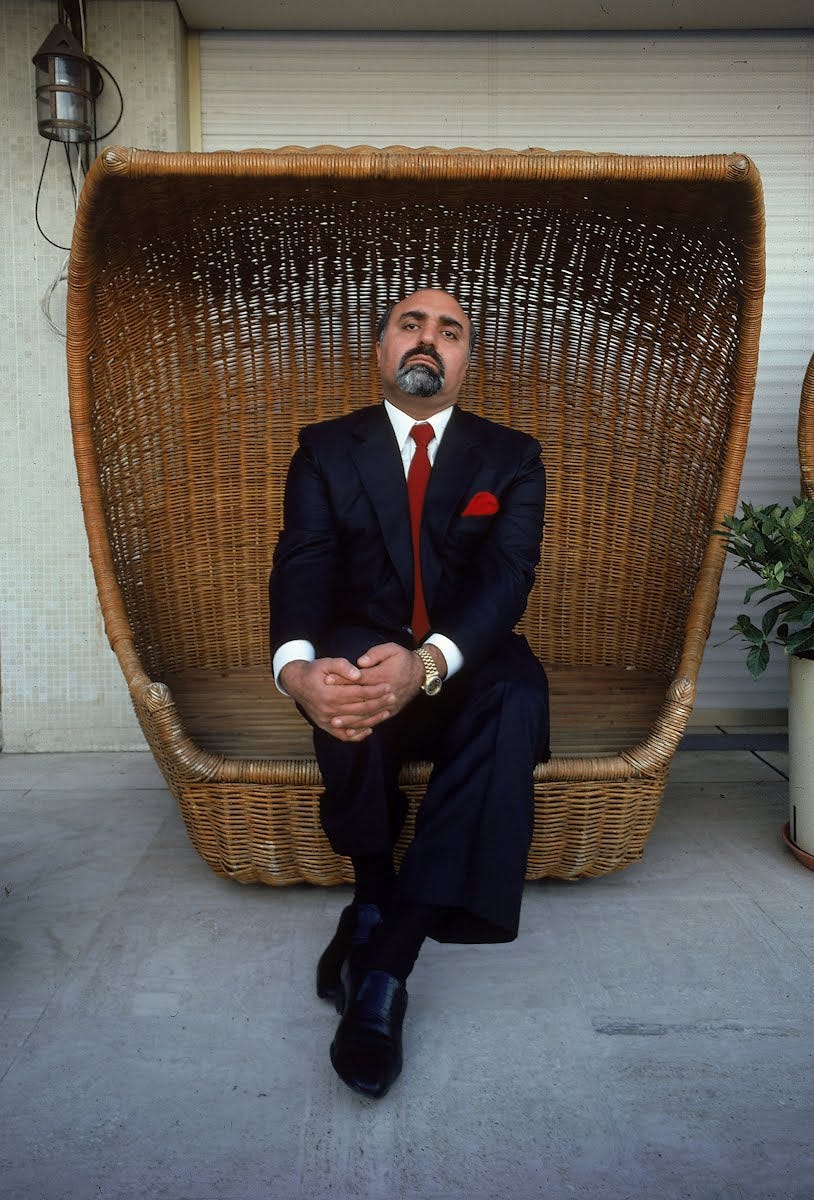
Talleyrand caught up with the old rogue* and solicited his thoughts on recent events.
T: You have spent many years, one could say, tending relationships amongst Iran, Israel, and the United States. What do you make of the current impasse?
G: There’s no impasse. There’s a perception of a ‘wedge’ between the USA and its protégé. Enemies are exploiting it, as anyone would expect.
T: Yes, but there’s a structural problem, too. This wedge isn’t being driven in a vacuum.
G: Correct. But a collapse of the world’s economy would benefit none of the involved parties. Is that what you mean by structural?
T: Not quite. The situation is contrary to the principle of tertius gaudens. There are three directly involved parties (and a number of others indirectly involved). Two of the three – Iran and the USA – are unable to dictate the behaviour of the third – Israel – which apparently desires to continue fighting. But no one party really benefits from the misfortune of the other two.
G: By that formulation there are actually four directly involved parties, including Hezbollah, yes?
T: Not quite. The Americans and the Iranians both treat Hezbollah, rhetorically anyway, as a quasi-independent entity; yet both claim that the war between Hezbollah and Israel is preventing a broader settlement; the Israelis in turn demand freedom of action against an enemy which is fighting them; but nobody other than Israelis can plausibly disassociate their or their enemies’ militancy from that settlement, which is practically impossible to do at the minute. The natural pattern of proxy relationships, to the extent that any exists, is reversed.
G: You’re over-thinking this, my friend. There’s always room for a deal.
T: For what, precisely? The status quo ante? Every time that comes up in a truce, the Israelis spoil it.
G: As well they should. The status quo dates not to 2025 but to 2015, or earlier. Iran would be in the free and clear.
T: Then suppose that you are a political Lazarus, reappearing at the right moment to offer a solution pleasing to everyone. What would it be?
G: Please do not make insinuations. I am retired.
T: No insinuation. I am posing the question hypothetically.
G: Well, hypothetically, you must start with the proposition that your ‘structural’ logic is not just over-thought but also overly general. That is to say, none of the parties works from a single motivation, or a single set of motivations. There are very many others, not only there but also in Asia, Europe, elsewhere. You must start, in other words, with the belief that there are enough parallel motivations to make a fortunate conjunction.
T: Which would be?
G: I repeat, please do not make insinuations…
T: Which might be?
G: I couldn’t possibly comment. But I should hope that a number of people in Lebanon and Israel would see a benefit in freezing the conflict with Hezbollah. Patriotism has nothing to do with it. I would extend the benefits of a deal to Syria and Iraq, for now. I can’t be more specific.
T: You say patriotism has nothing to do with it, but isn’t the survival of one or more of the parties at stake?
G: The survival of the USA is not at stake, even in an economic depression, which I can’t believe the powers-that-be would allow to happen over this. And – I might add, much to my dismay – the winds there have shifted, the consensus seems to be that Israel is something of an albatross. The survival of Israel and, to some extent Iran, is also not at stake, however, so long as the people running both countries find the means to separate posturing from principle. The opposite is true for Hamas, Hezbollah, and others. They will go down fighting to the last man over a principle, which for them is survival. Make of that what you will.
T: I see that I’ve succeeded at last in moving your thinking in a Cartesian direction… But I’m curious why you would imply that some Americans, Iranians, and Israelis would sell out their pet causes and maybe their countries, but that others would not do.
G: I am an Iranian patriot. Forever.
*Or someone claiming to be he.